 Valusaur
Japan Pokémon Card Stores Add Facial Recognition
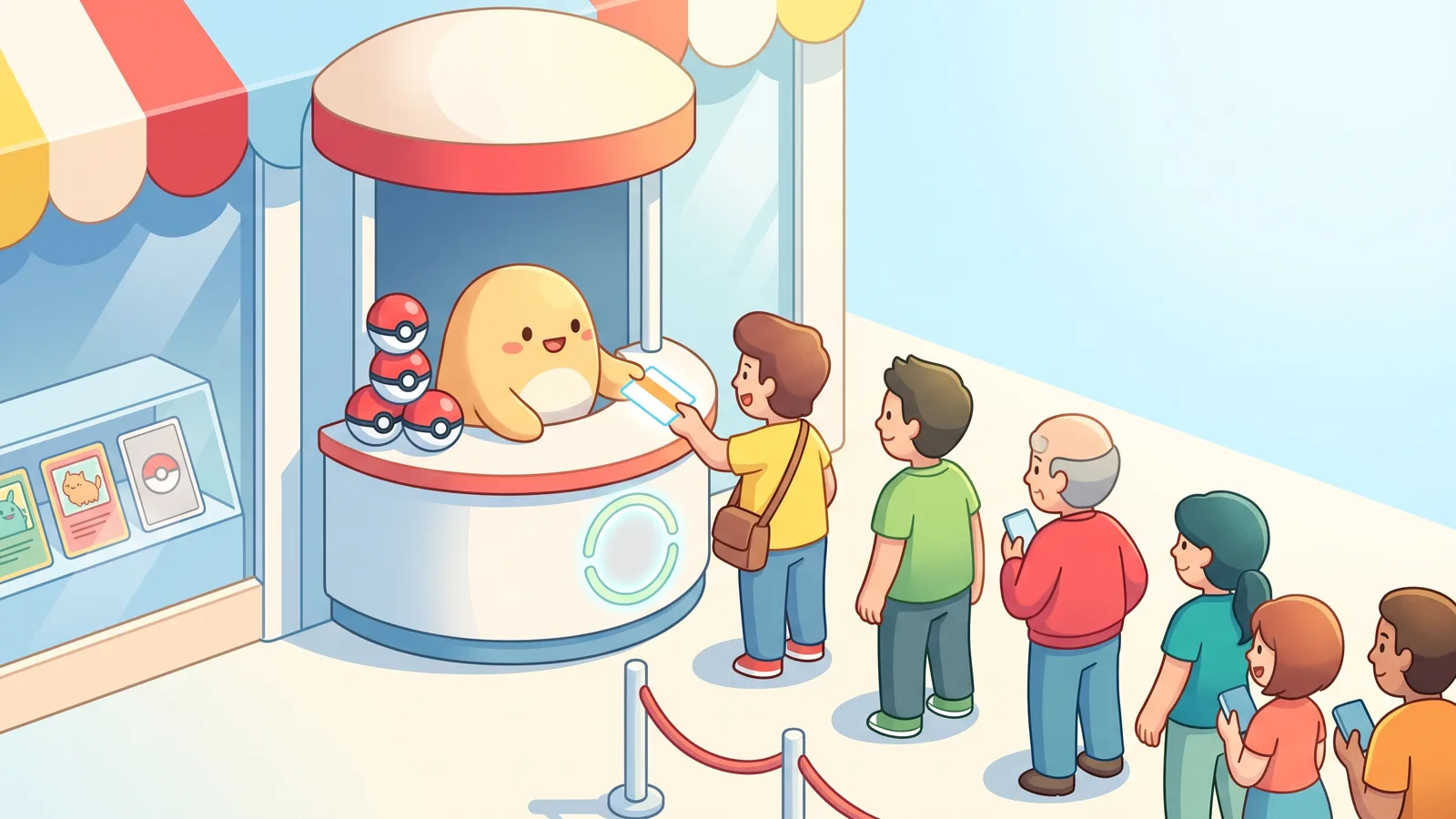
Japan's official Pokémon Card Store locations began scanning customers' faces at the door on July 31, limiting each shopper to one entry ticket per day to stop scalpers from cycling through the line. It's the second piece of a wider identity-verification push that also brings Japan's government My Number Card to Pokémon Center Online purchases starting in August, and together the two systems are starting to close off Japan's official Pokémon TCG channels to anyone who isn't a Japanese resident.
What is Japan's new facial recognition policy at Pokémon Card Stores?
The policy scans every customer age elementary-school and up at entry and at ticket pickup, limiting each person to one numbered entry ticket per day; a second attempt at either step triggers an alert and the customer is turned away. Consent to the scan is mandatory — decline it and staff won't hand over a ticket or let you in at all, according to Video Games Chronicle.
The Pokémon Company framed it as a fairness measure rather than a security crackdown on customers: "At Pokémon Card Stores, in order to provide a safe and secure shopping environment for all customers, to prevent crime, and to ensure compliance with appropriate entry and purchase rules, we will be using a facial recognition system" (Video Games Chronicle, July 27). Preschoolers are exempt but must be accompanied by an adult, and Mynintendonews reports facial data and visit counts are stored only "for the purposes intended" and deleted after a set period. Leave the store without telling staff, and you lose your spot for the rest of the day.
Which stores use it, and when did it start?
Facial recognition went live July 31 at five temporary "Pokémon Card Store" pop-ups — Natori, Chōfu, Higashiura, Hiroshima-Fuchū, and Chikushino — running through August 16, 2026, exactly the window in which Storm Emeralda released in Japan, according to FinalBoss. The Pokémon Company had announced the system on July 24, and photos from the Chōfu PARCO location circulated within days, per GosuGamers. FinalBoss describes the target behavior as "repeat visits, duplicate queue positions, and coordinated line activity" used to strip extra inventory out of a single release window — the exact tactic that turns a controlled product drop into a scalper feeding frenzy.
Timed to a Mega Evolution release, this is a pilot, not a permanent nationwide rollout. But it lands on the same product category we've been tracking since Storm Emeralda's import-vs-wait math first went live at roughly $150 a box — any system that keeps more boxes with in-person Japanese buyers instead of bulk resellers changes that math over time.
How does this connect to the My Number Card ID system?
Japan's Pokémon Center Online will require the government-issued My Number Card for select TCG purchases and for entry into Japan-based tournaments starting in August 2026, a policy first announced May 21 and aimed at the same scalping problem the store-level face scans target. Verified shoppers get better lottery odds; unverified ones can still enter a drawing but with reduced chances, according to Kotaku.
The My Number Card is Japan's national ID, used for tax filing and social services, and it ties purchases to a government-verified identity rather than just a store visit. Wargamer reports the underlying Digital Identification App is currently used for things like online banking and age-gated alcohol purchases, adopted by over 70% of Japan's population — and that Pokémon is "encouraging fans to sign up early" because the card itself takes one to two months to arrive after applying.
By June, the company had confirmed which products the September 30th Celebration launch would gate behind ID verification, including the ¥7,200 30th Celebration Box and the ¥27,500 Futuristic Box, according to Tokyo Weekender. That's the same release whose preorders sold out in hours and resold for hundreds of dollars — the exact outcome this ID system is designed to prevent for anyone who can get a My Number Card.
| Measure | Where it applies | Rollout | What's required | Duration |
|---|---|---|---|---|
| In-store facial recognition | 5 temporary Pokémon Card Store pop-ups: Natori, Chōfu, Higashiura, Hiroshima-Fuchū, Chikushino | July 31, 2026 | Facial scan + consent; one entry ticket per person, per day | Through August 16, 2026 |
| My Number Card ID verification | Pokémon Center Online purchases + Japan-based tournament entry | Rolling out August 2026 (announced May 21) | Government My Number Card verified via smartphone app; unverified entrants get worse lottery odds | Ongoing, no end date announced |
Why is Pokémon doing this now?
Both systems target the same problem: scalpers cycling through queues or lottery entries multiple times to strip a single release of stock before real collectors get a shot. A face scan closes the loophole a paper ticket alone can't — nothing stops someone from grabbing a new numbered ticket after leaving, except recognizing that it's the same face. Tying online purchases to a government ID closes the equivalent loophole for lotteries, where scalpers have historically used multiple accounts or devices to multiply their entries.
Neither system claims it will eliminate scalping outright, and both add friction for genuine collectors too — an extra consent step at the door, an ID card that takes weeks to arrive. The Pokémon Company's calculation is evidently that friction for everyone beats leaving inventory to whoever automates the queue fastest.
What does this mean for overseas collectors and import prices?
The practical effect is that Japan's official primary-market channels — Pokémon Center Online and, on a pilot basis, physical Card Stores — are becoming Japan-resident-only in practice, since a My Number Card requires Japanese citizenship or long-term residency to obtain. Overseas collectors who used to buy direct or lean on Japan-based proxy shoppers making repeat runs now face a narrower door, which pushes more demand onto Mercari, Yahoo Auctions, and import resellers instead of the manufacturer's own storefront.
That's a real shift for anyone weighing the price gap between Japanese and English printings of the same chase cards — a gap driven partly by import markup on top of scarcity. Our call: the five-store facial recognition pilot is too small and too short (16 days, one Mega Evolution release) to move box prices on its own. The My Number Card rollout is the one worth watching, because it's ongoing and covers Pokémon Center Online's biggest drops, including September's 30th Celebration. If it meaningfully thins out the bulk buyers who currently supply import resellers, expect the JPY-to-USD import premium to widen rather than shrink over the second half of the year. Track that premium as it moves — Valusaur pulls live TCGplayer and Cardmarket prices across all seven card regions, so you can watch the English/Japanese spread shift in real time instead of guessing at it.
FAQ
Do I need a My Number Card to buy Pokémon cards from Japan? Not to buy from third-party resellers, importers, or platforms like Cardmarket and TCGplayer. You only need one to buy directly through Pokémon Center Online's ID-gated lotteries or to enter Japan-based tournaments once the August 2026 rollout takes effect.
Does facial recognition apply to Pokémon Center stores outside Japan? No. The current system runs only at five temporary Pokémon Card Store pop-ups in Japan (Natori, Chōfu, Higashiura, Hiroshima-Fuchū, Chikushino) through August 16, 2026, timed to the Storm Emeralda release window.
Will this actually stop scalping? It closes the specific loophole of re-entering a line or resubmitting a lottery entry as if you were a new person. It won't stop scalpers who buy their one legal ticket's worth and resell it, or who operate with multiple real identities.
What happens to the facial recognition data Pokémon collects? The Pokémon Company says it stores only visit counts and facial image data, manages both within the scope needed for the purpose, and deletes the data after a set period, per its public statement reported by Mynintendonews and Video Games Chronicle.
Does this affect Storm Emeralda prices specifically? Not directly on its own — the pilot is too narrow to move box prices by itself. It matters more as an early test of a tool Pokémon could expand to bigger releases, including September's 30th Celebration set.
Sources
- Pokémon card stores in Japan are adding facial recognition to stop people breaking their purchasing rules - VGC
- Japan: Pokemon Card Stores require facial recognition for entry and purchases - My Nintendo News
- Pokémon TCG stores in Japan introduce facial recognition to stop scalpers buying cards twice daily - GosuGamers
- Pokémon's Facial-Scan Store Rule Makes Every Japan TCG Visit a One-Shot Entry - FinalBoss
- Pokémon Company In Japan Demands ID Checks To Fight Scalpers - Kotaku
- The Pokémon TCG's new anti-scalper measures may well break Japan's government national ID app overnight - Wargamer
- Pokémon TCG Proposes Japan's "My Number" ID Verification To Stop Scalpers - Tokyo Weekender
Wondering what your own cards are worth?
Download on the App Store